The short answer: design the campaign before the bag
For a beauty promotion, begin with the recipient, what goes inside, where the bag is handed over and what action the brand wants afterward. Then choose a cosmetic-bag direction, branding method and presentation format that serve those decisions. Ask for a quotation only after quantity, artwork, packing and destination are described on the same version of the brief. A supplier can discuss possibilities earlier, but an early price without a shared scope does not tell you what the recipient will actually receive.
What this guide helps you decide
Use the following questions as an approval sequence, not as a list of features to add. Is the bag a gift with purchase, a launch-kit component, a retailer handout or a reusable organizer? Will it arrive empty, hold approved products or sit inside a larger gift pack? Must staff hand it out quickly, or will a warehouse pack each unit for individual delivery? The answers change opening access, dimensions, label placement and packing instructions. They also identify who in the buyer organization has authority to approve the physical result.
What a photograph cannot decide
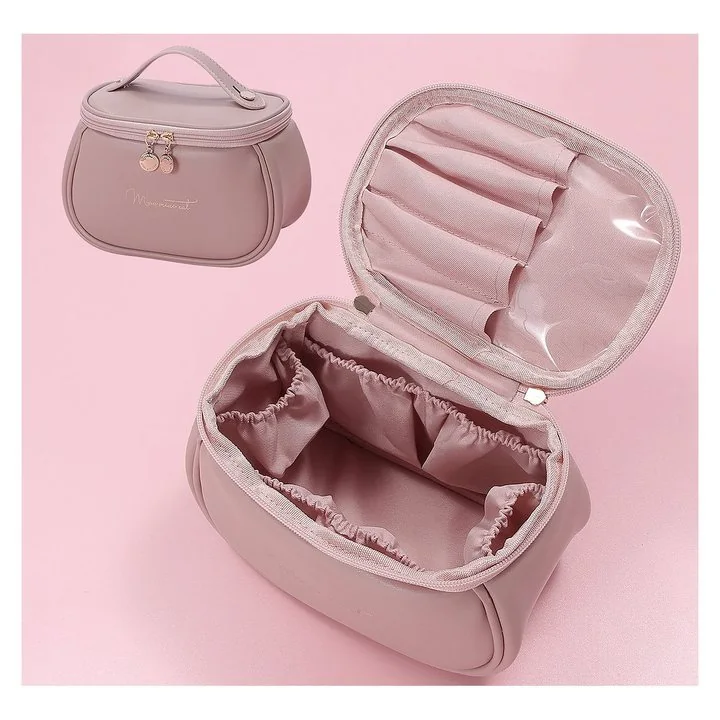
A catalog photo is a helpful starting point for shape and visual direction, not proof of exact dimensions, material, stock or logo suitability. A digital mock-up is useful for discussing placement, but it does not reproduce texture, zipper behavior or how the bag looks when filled. Treat each image as a reference with a stated purpose. Ask SmartPro to confirm the proposed product version and sample route for your specific brief before promising the style to a retail or campaign team.
Identify the recipient and the moment of use
A beauty-brand promotional cosmetic bag must make sense to someone who did not sit in the planning meeting. Write a one-sentence recipient scenario: who receives it, why, with what products and in which setting. For example, a retailer handout and a direct-to-consumer launch kit can share a visual theme but require different packing, instructions and handling. The scenario is a decision filter: if an added pocket or decoration does not help the recipient or brand objective, it should not silently become part of the specification.
Segment by the job the bag performs
A gift-with-purchase bag may need to sit beside other products at checkout and communicate the campaign immediately. An influencer or press kit may be opened on camera and needs a controlled first impression. A travel-size skincare set needs the proposed contents to fit and remain easy to access. A customer-loyalty gift may be valued for continued everyday use after the original promotion. These are possible planning scenarios, not claims about which products SmartPro currently supplies. Select one primary job and note any secondary one before selecting a style.
Record distribution constraints early
Ask the channel owner how the gift reaches the recipient. Will store staff fill it, will an agency assemble a kit, or will a fulfillment partner pack and label each unit? Who supplies the products going inside? Does the bag need an external barcode, a campaign insert or a protective sleeve? Can the location receive master cartons, and who checks assortments? A beautiful sample can still fail operationally if the team that hands it out was never asked how it will be stored, opened or replenished.
Build a contents-first cosmetic bag brief
The intended contents should be written down before a buyer settles the bag's dimensions. List each product by physical dimensions, orientation and packaging, including any outer carton or sleeve that will remain on it. If the kit is not final, identify the largest plausible item and label the measurement provisional. Do not assume a photograph reveals usable internal capacity. A pouch can look roomy from the outside while a narrow opening, gusset or internal seam makes insertion difficult. The sample should be tested with the actual approved contents whenever possible.
Separate mandatory fit from optional organization
Make a simple contents sheet with four columns: item or item family, supplied by whom, approximate physical envelope, and whether it must fit upright or merely lie inside. Add a note for components that should not touch or obscure one another. Then distinguish mandatory functions from preferences: for example, a secure opening may be essential, while a divider may be optional. This prevents a quotation for one uncomplicated pouch from being compared with a second quote that assumes additional internal construction. If the contents later change, update the sheet rather than relying on memory.
Test the way a recipient uses the opening
The bag's opening should support the real action: inserting a boxed item at packing, taking out a product without damaging a label, or finding a small tool after the launch. Ask the sample reviewer to open and close the bag repeatedly with the intended contents in place. Note whether the zipper path, top edge, handle or lining interferes. These are buyer-use observations, not laboratory test claims. Record a photo or short video of the agreed packing orientation so the packing team is not forced to improvise later.
Choose the bag type without confusing nearby categories
The phrase cosmetic bag can describe several very different objects. A compact makeup pouch, a wider vanity case and a travel toiletry organizer do not necessarily meet the same buyer need. Use the contents and distribution scenario to decide whether a simple pouch is enough or whether the project needs a structured interior, a different closure or more protection. The commercial category page shows available visual directions, while this article explains how to decide between them for a beauty campaign. It is not a substitute for a confirmed product specification.
When a makeup pouch is the right starting point
Start with the custom makeup bags collection when the program centers on cosmetics, beauty tools, sample sets or a branded keepable gift. Browse the supplied styles to discuss silhouette and intended presentation; then send actual contents, artwork and packing requirements so a workable version can be checked. Avoid choosing only by external color. The end user's view includes the inside, zipper, label and the appearance of the bag after it has been handled, not just a front-facing product photograph.
When the use case belongs elsewhere
If the main contents are taller travel containers or the request centers on wet-item separation and bathroom use, compare the toiletry bag category rather than forcing a cosmetic pouch to do a different job. If the campaign needs an outer carrier for a box or multiple gifts, a branded tote may be the outer layer while the cosmetic bag remains the keepable inner item. Link each role to a separate specification so the two products do not become one vague line on a quotation.
Make the brand visible without treating a mock-up as approval
The best logo treatment is the one that stays legible on the proposed physical surface and looks appropriate when the bag is in use. The planning question is not simply how large a logo can be printed. It is what the recipient should notice, what the retailer or marketing team needs to recognize, and whether the proposed surface and construction can support that presentation. No universal print dimension or decoration method is promised here. Confirm artwork requirements and the feasible application method against the selected material and sample.
Approve the real mark, not a generic placeholder
Supply the final approved logo file, any brand-color reference, permitted clear space, orientation rules and restrictions on moving or simplifying the artwork. Say whether the buyer expects a discreet woven label, a visible surface mark or a presentation coordinated with packaging. If the artwork contains small lettering or delicate lines, ask to review its appearance on the proposed material before locking the treatment. The brand-material and logo guide covers the broader surface decision; this campaign brief records which outcome your beauty brand actually needs.
Document what the approval covers
A flat digital proof can approve spelling, general placement and artwork version. It does not automatically approve physical shade, hand feel, print behavior, embroidery texture or how the mark sits near a seam. State whether an approval is for artwork only, a representative print test or the full packed bag. Save the accepted file name and sample reference together. If the brand team later asks for a new color or moves a mark, the change should be treated as a new decision with possible cost and timing consequences, not silently attached to an earlier sign-off.
Plan the unboxing and the packing handoff
For a gift, the first visible surface might be a sleeve, insert or outer pack rather than the bag itself. Write down what the recipient encounters in order: outer shipping pack, retail display, individual protection, printed insert, cosmetic bag and contents. This sequence exposes gaps that product-only briefs miss. A promotional bag can carry the right logo and still arrive with the wrong insert, inconsistent assortment or packaging that a store team cannot open quickly. Treat the packed unit as the object being approved.
Define the unit that will be counted
Ask whether the quote and order refer to an empty bag, a bag with a supplied insert, or an assembled kit that someone else fills. Name the party responsible for providing each insert, product, hangtag, barcode and protective element. Record whether each color or campaign variant needs a separate label or carton mark. Without this list, two quotations may appear comparable while including different work. Do not assume SmartPro supplies cosmetic products, gift boxes, retail labels or kit assembly unless the specific project scope is confirmed in writing.
Make receiving instructions usable
The distribution team needs to identify which cartons contain which bag version and how many units should be inside. Agree the carton-mark information, packing list and receiving contact before dispatch. If stores, agencies or an e-commerce warehouse will split the goods, ask them what label or variant code they need to avoid opening every carton. The desired outcome is not more paperwork for its own sake; it is fewer wrong-color handouts, missing inserts and unexplained shortages at the moment the campaign goes live.
Build one quotation scope that every partner can answer
A price comparison is useful only when every supplier answers the same question. Send one controlled brief with the bag reference, recipient use case, intended contents, quantity by style and color, artwork, packing unit, destination and target arrival date. Mark undecided items clearly instead of hiding them. Ask each partner to state what is included, what is excluded and which assumptions change the proposed route. The resulting quote comparison should show scope differences beside price, rather than treating a low initial total as proof of a better finished campaign.
Avoid false precision about minimum orders
SmartPro states that selected feasible projects can start from 50 pieces per style and per color. That is a conditional starting point, not a promise that every material, decoration, package or variant can be produced on the same terms. If a beauty launch has multiple shades or several printed messages, list each version separately. Ask how the combination affects feasibility and setup before multiplying a single quoted unit price across the entire program. The small-batch order guide explains how style and color fragmentation changes budget planning.
Compare like with like
A comparison sheet should have separate rows for the proposed bag version, logo application, approved sample reference, labels, individual packing, outer cartons, transport scope and any buyer-supplied items. Ask each partner to identify whether the quoted sample resembles the final bulk version and what still requires confirmation. Where a quote is conditional, preserve that condition in the decision record. This is more useful than choosing a supplier based on a unit price that omits the presentation and distribution work that makes the promotion successful.
Assign approval owners before sampling begins
Marketing may own the visual brand result while procurement owns commercial scope, and a fulfillment team owns packing information. None of those responsibilities should be inferred from a job title alone. Name a final decision owner for each deliverable, decide who consolidates comments, and record what evidence closes an approval. A cosmetic bag sample can pass a beauty team's appearance check while failing the product-fit or receiving test if those reviewers are brought in only after the final sign-off.
Give every sample round one purpose
The first physical sample can answer shape, capacity and surface questions. A later review can settle artwork and recipient presentation. The final controlled reference should record all accepted differences and the packed-unit requirement. These are possible decision stages, not a promise about the number of sample rounds included with any order. Confirm revision scope, charges and timing for the actual project. The sample-round planning guide explains how to consolidate feedback instead of sending several conflicting revisions.
Protect the version handed to production
Use a simple version record: reference bag or drawing, dated artwork, material and color reference, approved logo placement, packing description and list of open exceptions. A comment such as “looks fine” is not enough if the reviewer saw only one angle or an empty sample. Put the exact approved views and remaining conditions next to the sign-off. If a later change is requested, ask what it does to price, sample status and timeline before authorizing it. The controlled record protects both buyer and supplier from differing memories.
Work backward from the date the recipient needs it
A launch date is not the same as a factory dispatch date. Build the calendar backward from when the recipient, store or agency must have usable goods. Include the date for receiving, transport, packing, bulk production, final sample approval, artwork review and the initial brief. The sequence reveals whether the deadline leaves enough room for decisions that the buyer controls. A project may need simplification if the approval path or supplied contents are still changing; an unreviewed schedule should not be presented as a confirmed delivery commitment.
Treat published timing as a planning baseline
SmartPro's stated usual sample-making time is 3–6 days after payment, subject to materials, construction and tooling. Its usual first-order bulk-production range is 25–30 days after payment and sample approval; repeat orders with an applicable approved specification are usually 20–25 days. Transport is separate and depends on destination and shipping method. These owner-confirmed baselines are not a project guarantee. Ask SmartPro to confirm the actual route and milestones against the final contents, artwork, packing and order scope before committing to a campaign date.
Make late changes visible to the whole team
If a brand approval is delayed, the calendar should show which later stages may move, not merely display a red warning beside the event date. Decide who can approve an alternate material, simpler decoration or split delivery if one becomes necessary, and what the brand will not compromise. Do not substitute a design, content assortment or label without written buyer approval. The branded-bag procurement timeline gives the general project framework; this guide applies it to the recipient and kit decisions unique to a beauty promotion.
Check the delivered experience, not only the empty bag
Quality for a beauty campaign is judged by the delivered unit: its visible branding, function, contents fit and packing presentation. A buyer should approve a reference that shows how the bag is intended to be filled and handed over. Set a receiving check that a store or fulfillment partner can perform consistently. This is not a substitute for a factory inspection program or a claim that SmartPro owns a particular production line. It is the marketing buyer's practical check that the promised campaign object and the received object are the same.
Review the details the recipient will notice
On a physical reference, inspect the opening, zipper operation, accessible pockets, logo legibility, labels, visible color relationship and how the bag looks when the proposed contents are inside. Check that packaging does not cover a required message or damage the surface in transit. Agree in advance which observed differences are acceptable and who approves an exception. A photograph can help document a decision but should not replace a physical check where feel, fit or color matters to the brand. Keep the accepted reference identified for the full project.
Make destination checks simple enough to happen
A receiving instruction can ask the team to confirm variant code, carton marks, quantities, visible packing condition and a small set of agreed appearance points. The exact method and any sampling plan should be defined for the order, not invented in a generic blog article. Record who reports a mismatch and how they identify affected cartons. That creates a useful feedback loop before a national store handout or distributed influencer campaign makes a small labeling mistake difficult to retrieve.
Keep claims and legal responsibilities with the correct company
SmartPro Gifts is the multi-category custom-bag project contact represented by this site. Its parent, Shenzhen Hongzhao Handbag Co., Ltd., specializes in outdoor and functional bags and has its own facility and dated manufacturing documents. A cosmetic bag photo in the SmartPro catalog does not by itself establish which legal entity will manufacture a specific order. Ask for the proposed production route and document holder when those facts matter to your procurement policy. Do not treat a parent-company certificate as a SmartPro certificate.
Request evidence tied to the proposed order
If your organization requires site, quality-system or social-compliance evidence, say which requirement applies and ask whose facility would actually be involved. The parent-company factory information and certificate documents are available for review only where relevant to the confirmed route. A document can establish that it belongs to its named holder; it does not prove that every catalog style on a separate company website was made there. SmartPro should explain the actual supply arrangement for the buyer's project before the buyer relies on any facility claim.
Keep beauty-product compliance separate from bag sourcing
A branded pouch is not the cosmetic formula, its ingredient label or its market authorization. The buyer must identify who owns product claims, ingredient or labeling review, licensed artwork and any promotion-specific legal requirements in the destination market. SmartPro can receive the approved artwork and packing instructions for the bag project; this guide does not provide legal or regulatory advice. Avoid adding “compliant,” “certified” or “sustainable” to campaign copy without the specific supporting evidence and approval that those words require.
Send a decision-ready beauty campaign brief
A useful first inquiry makes the next conversation narrower. State the campaign purpose, intended recipient, product and packaging contents, bag reference, target quantity by variant, logo files, packing responsibilities, delivery destination and required arrival date. Mark any item that is still provisional. SmartPro can then identify feasibility questions, the sample reference needed and the production route to confirm. A buyer gets more value from a clear list of unresolved decisions than from an instant answer that quietly assumes details that have never been approved.
Copy this brief into your internal request
Campaign and channel: ______. Recipient and handout moment: ______. Contents, supplied by whom and physical sizes: ______. Bag style reference and must-have functions: ______. Brand files, color direction and decision owner: ______. Quantity by style and color: ______. Individual packing, inserts, labels and carton marks: ______. Destination, receiving contact and usable-by date: ______. Open questions and acceptable alternatives: ______. Each blank is a prompt to find a real answer, not permission for a supplier to invent one. Attach the current artwork version and a photograph of the intended contents where available.
What the buyer should get back
Ask for a response that separates confirmed scope from assumptions: proposed bag direction, missing physical references, feasible decoration approach to test, packing responsibilities, sample decision, quote inclusions and exclusions, and the next approval milestone. If more than one route is possible, compare them by recipient experience and approval burden, not only by initial unit cost. Send the project brief to SmartPro when you can identify the key decision owner and the intended delivery context. Keep the copy you sent so later quotations can be checked against it.
Choose the right product route
Review makeup bag styles for the campaign pouch, or toiletry bag styles when the contents call for a travel organizer. The product page handles style and sourcing questions; this guide handles the campaign brief.
| Campaign decision | Buyer must supply or approve | What to confirm before order |
|---|---|---|
| Recipient and contents | Channel, actual kit items and who supplies them | Bag fit and packing orientation |
| Bag direction | Style reference and must-have use features | Project-specific sample and specification |
| Brand presentation | Final artwork, color reference and approval owner | Physical result on the proposed surface |
| Commercial scope | Quantity by style/color and packed-unit definition | Included work, assumptions and exclusions |
| Delivery | Destination, receiving contact and usable-by date | Approved milestones and transport responsibility |